
Wax sand: a candle in 10 seconds or a waste?
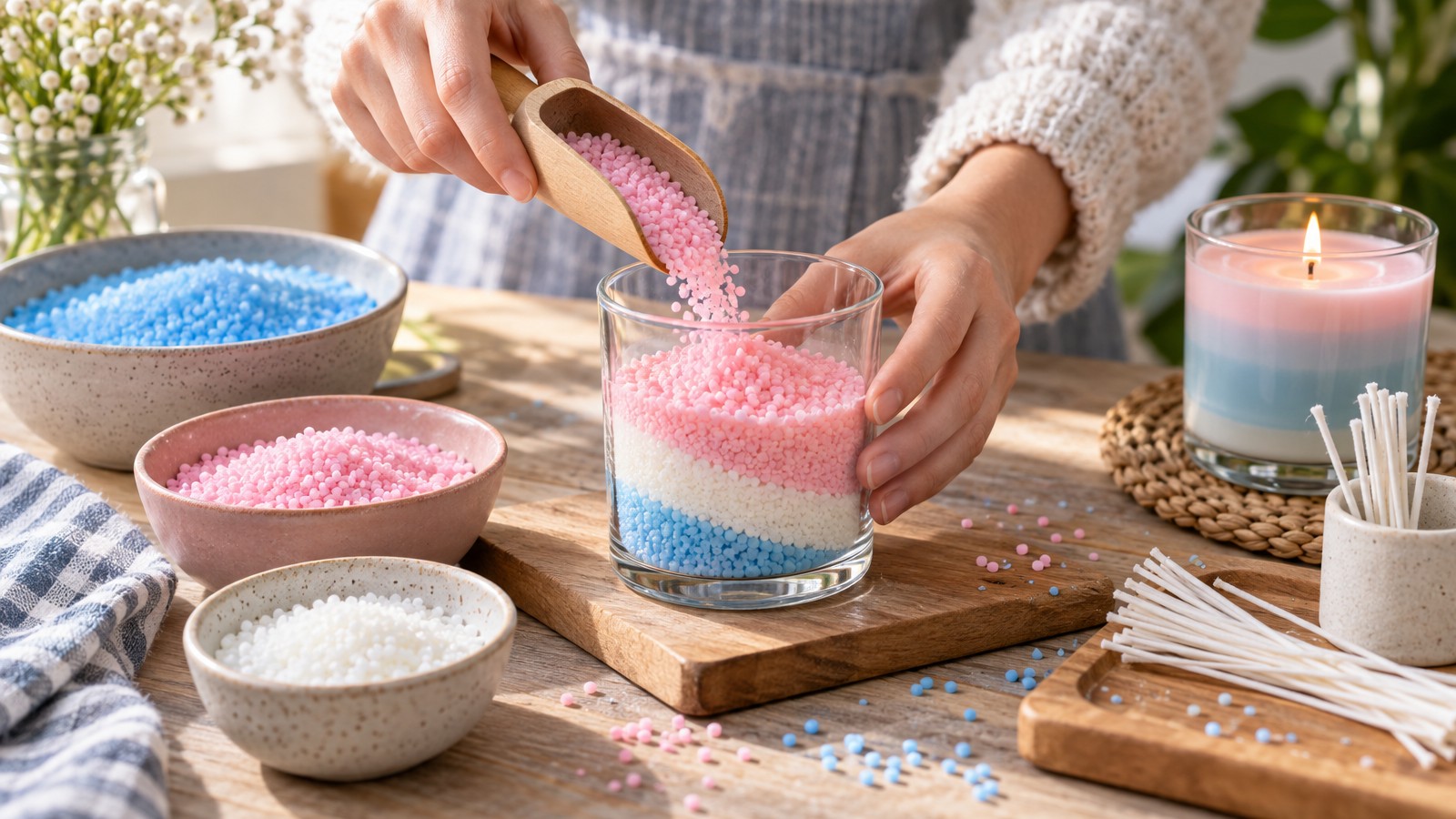
You bought 200 grams of colored wax granules for eight euros. At home, a beautiful pyramid greeted you in the glass — a blue layer, a pink layer, a white top, just like in that Instagram video that tempted you. You lit the wick and sat down at the table feeling like you had just made a candle in ten seconds. Thirty minutes later, you stood by the glass with a puzzled face: the wick sat submerged in a funnel-shaped pit, the flame was suffocating, most of that colored wax hadn't even melted. This is not an article about whether you did something wrong. This is an article about why it ended this way even with a perfect procedure — and how much that lesson actually cost you.
What exactly is wax sand and why did it become a trend
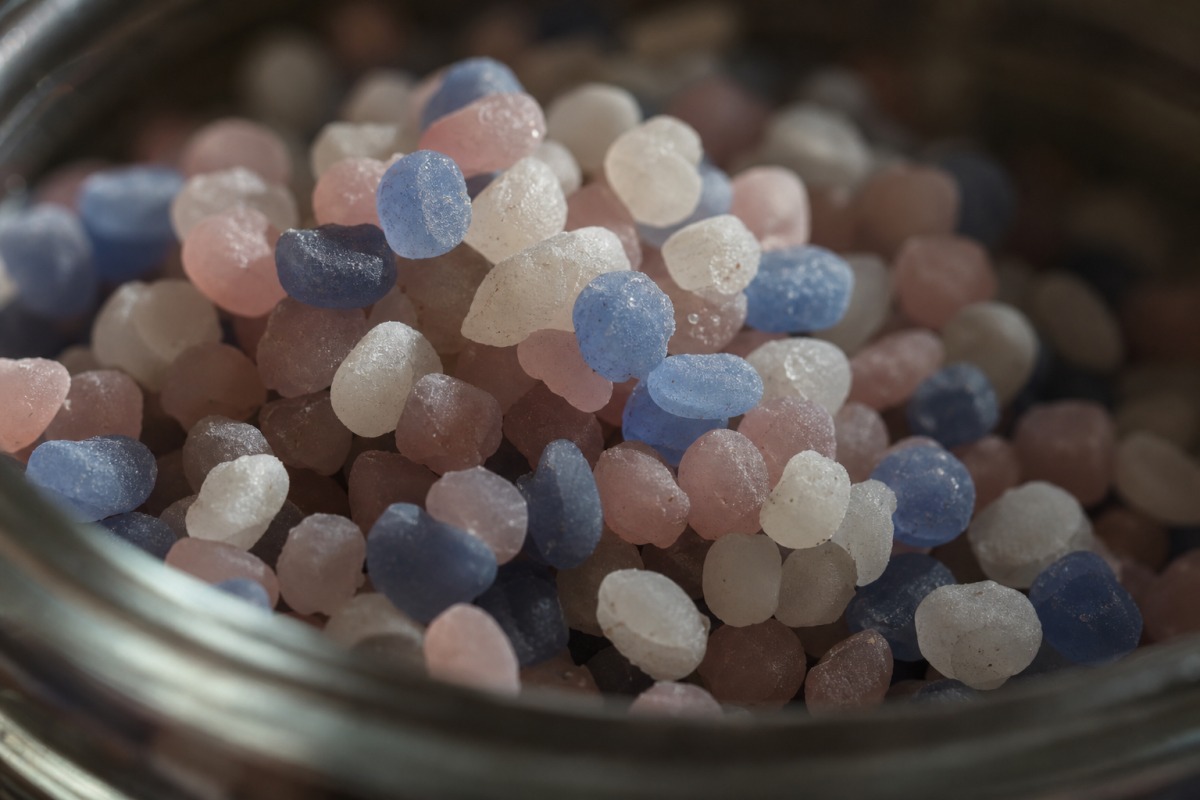
Wax sand is a granulate of paraffin or soy wax. The granules have a diameter of 2 to 5 millimeters, and packages are typically sold in 200-gram or 500-gram jars. The price of a 200-gram package ranges between 5 and 8 euros, which at first glance looks like a cheaper alternative to ready-made candles. The seller provides a glass jar, a pack of cotton wicks with a metal base, and instructions that fit on one line: pour, insert, light.
The marketing premise sounds elegant. You pour your own candle in ten seconds, combine colors into layers, make a birthday gift without wax drying, without hot accidents, without the messy pouring process. In reality, however, the granulate never inherited what makes poured wax a functional fuel. The granulate is format-wise close to sugar or salt, but physically it has one fundamental property that disqualifies it from the role of honest fuel for long burning: air remains between the grains.
The bulk density of poured granulate is approximately 600 kilograms per cubic meter, while the density of solid poured wax reaches around 900 kilograms per cubic meter. The difference represents roughly 33% air located between the grains. It looks like a technical detail, but it is precisely this air that decides everything that follows.
The anatomy of disappointment: what actually happened in that glass
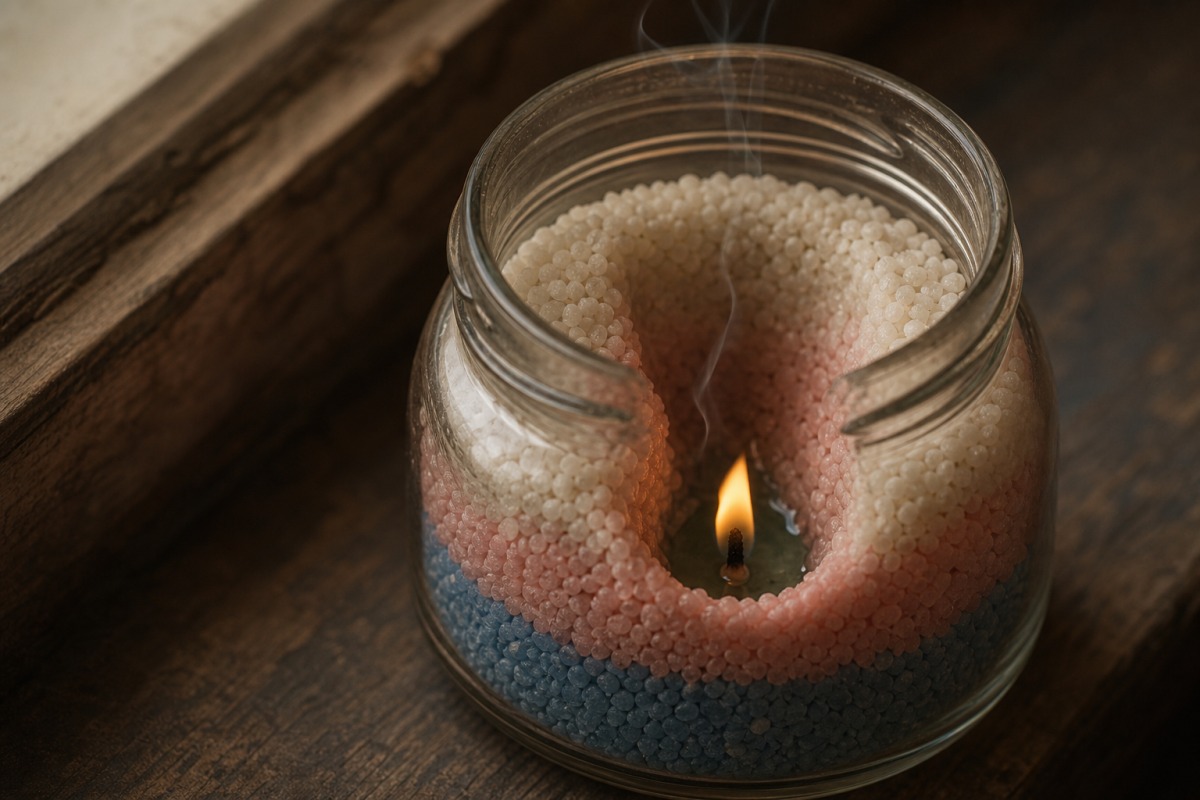
When I summarize the hundreds of reports that come into the NOBAMO inbox from people experimenting with wax granulate, it is always the same scene. First, excitement, layering colors, a photo for stories. Then the first lighting and 15 minutes of joy while the flame stands nicely above the surface. And then the moment when you notice that the wick is going down faster than the wax around it. The flame shrinks, smokes, gradually disappears into the hole it has dug for itself. After 30 minutes, the candle is done.
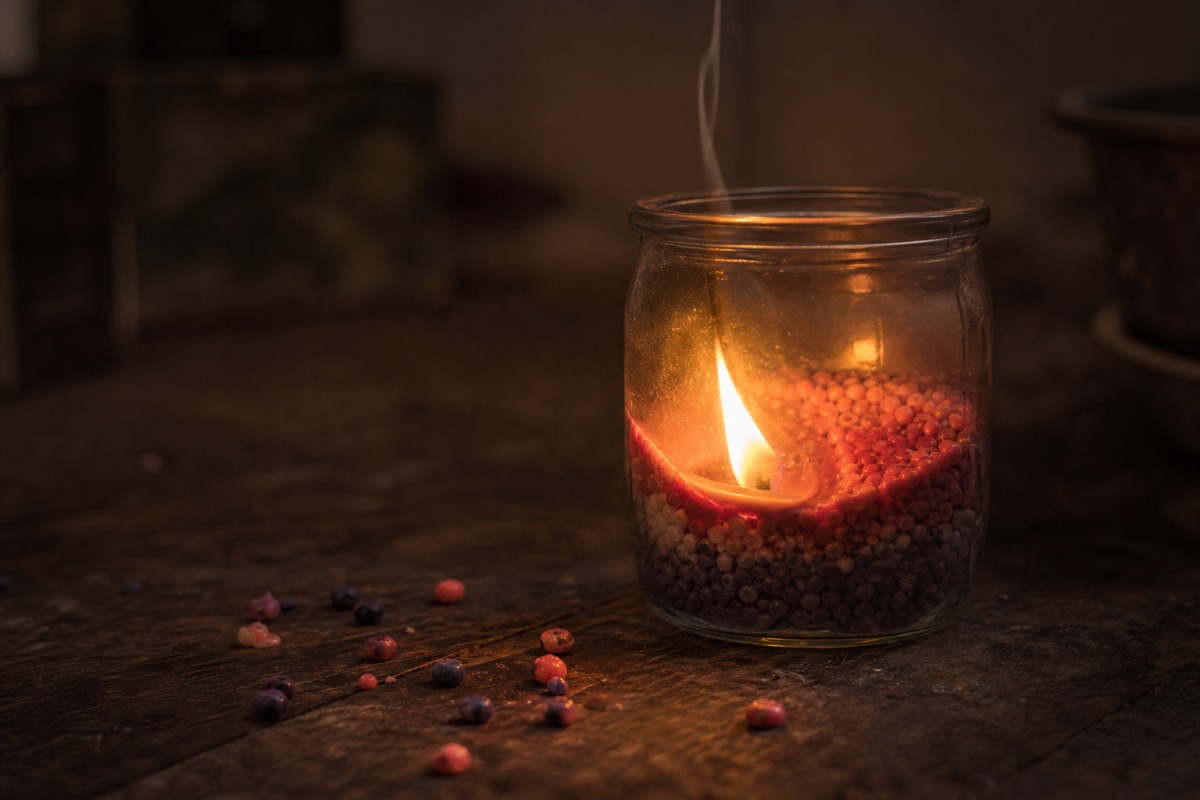
What happened: the loose granulate did not behave like a candle. It behaved like a pile of insulating beads with a wick in the middle. While the flame burned, it only melted a narrow column of wax directly beneath itself. The surrounding granulate remained cold. But the melted wax had nowhere to go because there are air gaps between the grains below it. So it sank down, created a cavity around the wick, and the wick quickly drowned in a pool that was too deep. Of the 200 grams you bought, only a small portion was consumed during this single burn — roughly one third. The rest still sits on the walls of the glass: dry, colorful, and unused in this burning method (technically, you can collect it and use it again after threading a new wick, but you expected something different from a "candle in ten seconds").
This is not a product defect. It is a predictable outcome of a physical problem that wax sand manufacturers either do not realize or hope the customer will evaluate as a "nice decorative piece" and not complain. Observations from community forums like /r/candlemaking, which I went through while verifying my own doubts about granulate candles, show a very consistent pattern: in the vast majority of attempts, the wick sinks into a funnel-shaped pit typically within an hour. The community calls this knot drowning and it is such a reliable phenomenon that most experienced candlemakers simply recommend ignoring granulate.


The physics of the capillary effect: why the wick needs solid wax
A classic candle works on a principle that physics knows intimately. A cotton wick absorbing liquid wax is a textbook example of the capillary effect, the same one that allows a kerosene lamp to lift fuel from the reservoir to the burner. The wick contains thousands of microscopic pores between the fibers. Liquid wax holds together thanks to surface tension, thanks to cohesive forces between molecules. When you dip the wick into such a cohesive liquid, the wax rises up the fibers and in the flame zone turns into vapor, which is the actual fuel. The flame burns on vapor, never on solid wax.
Loose granulate cannot serve this mechanism. The grains touch each other, but there is an air network between them. When you light the wick, the flame first melts only the immediate surroundings. A small puddle of liquid wax forms, which should supply the wick. Here comes the first divergence from a poured candle: the liquid wax has nowhere to flow because beneath it there is more air than wax, and what has melted seeps downwards between the grains, out of reach of the wick.
The thermal conductivity of solid soy wax is 0.15 to 0.20 W/m·K. The granulate behaves differently because air, which is an excellent insulator, is present between the grains. Heat from the flame spreads slowly sideways through the granulate, but quickly downwards because gravity pulls the melted wax away. This creates what the candle-making community calls a funnel-shaped pit around the wick, technically a melt pool tunnel.
According to a peer-reviewed study on wick and wax dynamics published in the journal Combustion and Flame (ScienceDirect, 2023), the stability of a candle flame critically depends on consistent capillary transport of wax along the entire length of the wick fibers. If the supply is irregular, the flame begins to oscillate, the wick carbonizes faster, and in extreme cases, it drowns in the molten pool. The National Candle Association repeatedly emphasizes in its materials on safe candle burning that a stable candle needs an even layer of solid wax around the wick, which melts at a controlled rate.
Five mistakes everyone makes with wax sand
Before we get to the experimental numbers, let me go through five specific things that are done wrong. Not to persuade you to try the granulate again. Most of these mistakes cannot be avoided anyway, as they stem from the very nature of the material. Rather, it's so you can see why the "fixes" from TikTok don't work.
Mistake 1: Wick too thin. Granulates are typically sold with a universal cotton wick intended for a solid wax pillar candle with a diameter of 5 to 7 cm. But loose granulate requires a wick with completely different thermal characteristics because it must overcome air gaps. In practice, you would need a wick one to two sizes thicker, and even that wouldn't solve the capillary effect problem, only prolong the agony slightly.
Mistake 2: Layering colors in blind faith. Those pretty gradients on social media were made by someone who poured granulate into a glass for a photo, lit it for 90 seconds, and saved the video. In real burning, these layers don't help at all because the wick carves its funnel-shaped pit only downwards and sideways, so out of your four colors, at most one actually meets the flame.
Mistake 3: Glass too narrow. In a narrow glass, the funnel-shaped pit forms even faster, and the wax melted on the walls has nowhere to retreat. The final result: the sand remains visibly on the walls at its original height, but in the middle you have a chimney with a drowned wick.
Mistake 4: Trimming the wick before lighting. With a solid candle, the wick is trimmed to 5 mm before each lighting to prevent an overly large flame. With granulate, this does the exact opposite of what you want: a shorter wick means a smaller flame, a smaller flame means less heat for the surrounding granulate, and it drowns even faster in the hole it digs for itself.
Mistake 5: Believing that "the second burn will even it out." It won't. After the first burn, you already have a solidified "pit wall" of wax around the former wick. The second burn either won't find the wick at all (drowned), or it will dig an even deeper hole. By the third burn, the flame usually gives up entirely.
Burn rate: granulate disappears significantly faster with the same wick
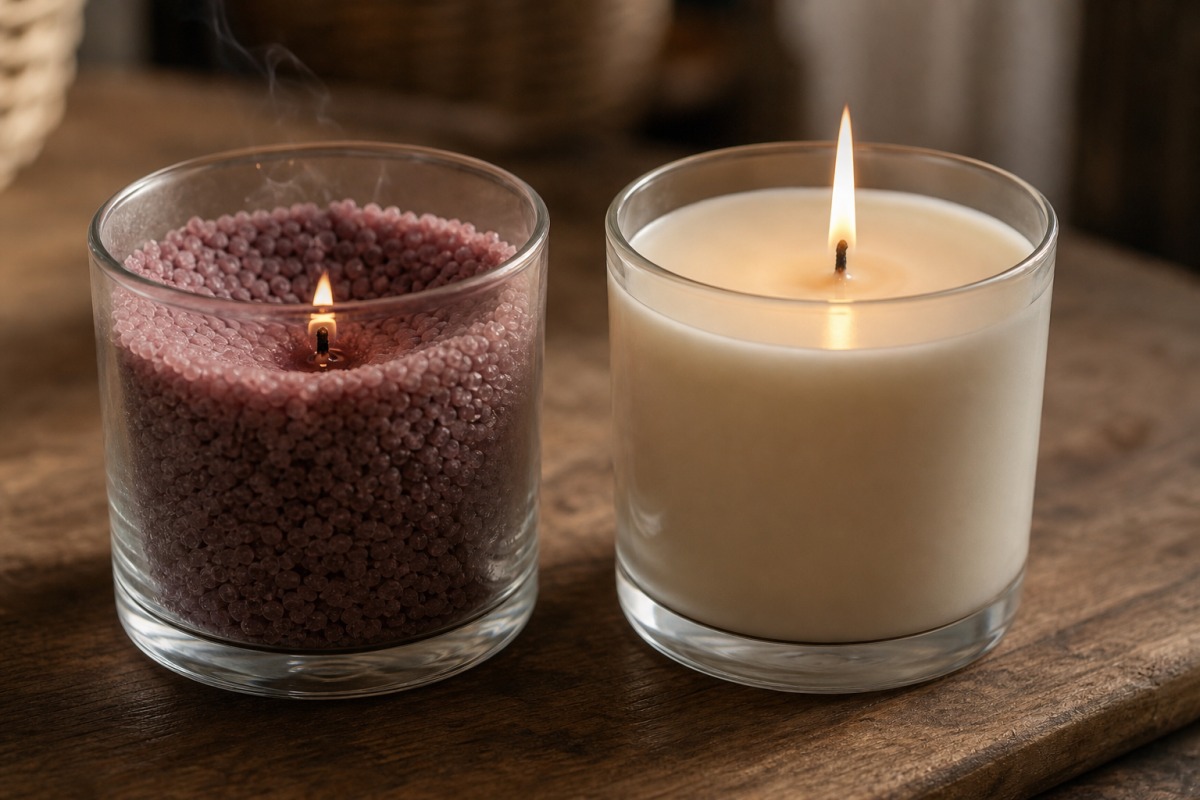
Wax sand manufacturers do not provide these numbers on the packaging: with the same cotton wick of 1.5 mm diameter and one continuous burn, loose granulate disappears noticeably faster than poured wax of the same chemical composition — on the order of several times faster, because the flame effectively "consumes" only a narrow column beneath itself instead of a uniform melt pool. The cause is acceleration by air convection. The air gaps between the granules act as micro-chimneys. The flame draws air from below, the air passes around the granules, transfers heat deeper, and accelerates the entire melting process. A candle cast from a solid phase has minimal such acceleration because solid wax does not allow air inside.
Community observations from the platform r/candlemaking show a consistent pattern: with wax sand in a standard glass with a diameter of 7 cm and a wick of 1.5 mm, a roughly deep, narrow melt pool tunnel (on the order of two centimeters) forms within half an hour. With a candle cast from a solid phase with an identical wick and glass, the melted surface typically remains only shallow (a few millimeters) over the same time and has a regular circular shape. After two hours, the solid candle still burns stably, the melt pool has expanded to the full diameter of the glass, and the wick holds.
The same peer-reviewed study from the journal Combustion and Flame (2023) also models the relationship between wax density, wick geometry, and flame stability. As wax density drops below a threshold value on the order of magnitude lower than the density of poured wax (900 kg/m³), the pumping capillary effect ceases to function reliably, and the flame transitions into an unstable regime. Loose granulate at approximately 600 kg/m³ is well below this threshold. This is not something that can be overcome with a better wick — it is the thermodynamics of the material.
Real coverage: with one burn, you only use a smaller portion
The economic side of wax sand thus has one invisible bottom. From a 200-gram package costing 7 euros, only a smaller portion is actually activated during one continuous burn; the rest remains unused on the walls with this burning method (technically, it can be collected and reused after threading a new wick, saving some of the material — in this sense, granulate is marketed as refillable). The price of the granulate itself is comparable to a premium hand-poured candle by weight, but the calculation per burned volume versus per hour of burning is deceptive. Granulate provides roughly one to two hours of stable flame per session (then a tunnel forms and the wick drowns), while a premium hand-poured candle burns for tens of hours. With the same consumed wax weight, you get many times more hours of burning from a poured candle. A detailed cost-per-hour calculation is in the final Decision Tree section.
Interestingly, these numbers are strongly independent of the type of wax. Whether it's paraffin granules, soy granules, coconut granules, or a mix, the problem is geometric, not chemical. Air gaps and the missing surface tension in the scattered solid phase are dictated by the format, not the composition.
Why the TikTok video burned and yours doesn't
Now for an interesting question. If granules physically cannot work, how do those TikTok videos come about, where a 30-second clip shows you a beautifully burning layered candle? The answer lies in that thirtieth second.
For the first 30 to 90 seconds after lighting the wick, it actually burns, it hasn't yet dug a hole, the wax under the flame is just melting, the surface is still more or less level. This is precisely the window of time when the creator films a close-up of the flame for the video, does a slow pan across the layers, and cuts it. Viewers remember a nice flame. No one goes back to watch the video half an hour later to see how it turned out.
Sometimes it's not even 30 seconds of malice. Sometimes the author never actually tried letting the candle burn down even once. They made it for a photo, lit it for a shot, blew it out, and posted it. You at home bought the material in good faith, but you didn't buy those 30 functional seconds from the video; you bought all the seconds that come after.
You also have to factor in the second layer of marketing. Some e-shops selling wax granules describe the product as a "decorative candle mix" or "candle grit for layering." In the fine print at the bottom, there are often warnings like "intended for decorative use" or "burn time will vary based on application," which in translation mean: this material is not primarily intended to burn, and we do not guarantee liability for it. But the product image says the exact opposite: a glass with a flame, the hashtag #instantcandle, "save this idea." This is legal because the warning is there. Ethically, it's something else.

Safety: what the NFPA says about candles (and what doesn't apply to sand)
The second reason to consider granule candles with caution concerns safety. According to NFPA reports on candle fires, approximately 7,200 home fires caused by candles occur annually in the United States, representing 2% of all home fires. The CPSC, in its estimate of residential fires for the years 2018 to 2020, states that candles account for approximately 1.5% of residential fires and cause on average around a hundred deaths per year (the second highest number of deaths among so-called heat sources).
Granule candles represent a special subcategory of risk within this statistic, one that is almost never mentioned in public discussions by manufacturers. The funnel-shaped pit around the wick means the flame unpredictably approaches the wall of the glass. If the glass is thin or has cracks from thermal shock, the risk of cracking or localized overheating increases. Loose granules on the farther part of the glass may not burn completely, but if the candle is knocked over, they scatter across the surface, and every grain that touched the flame becomes a small autonomous drop of molten wax capable of adhering to fabric. A solid block candle has almost all its wax integrated into a solid block when knocked over.
The peer-reviewed study Petry et al. (2014) shows that scented candles pose no health risks under normal use. The word "normal" here carries a hidden convention: even burning, stable flame, continuous capillary wax transport. Granule candles systematically fall outside these parameters, and although this does not mean an automatic health risk, it does mean that any emission measurement taken on standard candles (including the refutation by the ECA in 2018 against the 2009 study from South Carolina State University by Massoudi and Hamidi, which was not peer-reviewed and was funded by a USDA soybean grant) cannot be mechanically transferred to granules.
When wax sand makes sense: three legitimate exceptions
To be fair, wax sand is not a universally bad tool. There are a few situations where I would consciously recommend it to anyone planning to buy it. There are three.
First, purely decorative layering without functional burning. If you want to make a colorful pyramid in a tall glass for a wedding table, which will burn for 20 minutes during the toast and then be put away by guests as a souvenir decoration, wax sand is a good tool. It looks magical, allows color combinations, and the 20-minute lifespan is exactly within the window where the funnel-shaped pit is just beginning to form.
Second, a mini scent tester before buying a larger candle. If you are hesitating between three scents in container candles and want to quickly verify whether a specific composition works in your interior, a granule mini-tester (50 grams, 2 to 3 euros) is an acceptable compromise. You'll burn it into a tunnel, but it served its purpose: you tested the scent without a full investment in a whole candle.
Third, repeated refills for delicate glasses. Some households use small glass cups (4 cm diameter) on the nightstand as 30-minute candles before sleep. Here, granules can work because the small diameter compensates for the rapid burn-rate acceleration, the melt pool doesn't reach depth, and the wick can handle it. Even in this case, however, the rule "you use a third, you pay the full price" applies.
Handmade candle making as an alternative
I have been working with vegetable waxes in the handcrafted production of candles under the NOBAMO brand for several years, and every piece of information I have written here has also been verified by me in practice. I also conducted the granule experiment in my early years, and I too wanted to see if I was asking the wrong question. The result was exactly as I describe above: half an hour of beauty, half an hour of disappointment, and the larger part of the package unused on the walls. Personal experience, not a hypothesis.
When I pour a soy or coconut candle in the workshop, the wax undergoes a two-stage tempering process to a precise temperature before pouring (typically 55 to 60 °C for soy wax, 65 °C for coconut wax) to prevent air bubbles or frosting on the surface during solidification. The wick is calibrated to the diameter of the container, and the wax is left to cure for 48 to 72 hours. This "curing" means that the fragrances settle evenly into the wax, and the candle does not drown or smoke upon the first lighting. The lifespan of a 240-gram container is 45 to 55 hours of continuous burning, which, from the same volume of wax you had in a 200-gram granule package, makes a candle that is many times more productive per burn for the same amount of wax.
Decision tree: three questions before buying
Before you click to purchase, ask yourself three questions that will decide for you:
Question 1: Do I want a burning candle or just a decoration? If it's a decoration for a 20-minute moment, granules will suffice. If you want a candle that is part of an evening, reading, bath, or dinner with friends, granules are out.
Question 2: What is my cost per hour of burning? A 200-gram granule container for 7 euros provides, during one continuous burn, approximately one to two hours of a stable flame (then tunneling and the wick drowns), so the cost per hour is roughly several euros. A poured vegetable wax candle for 18 to 25 euros burns for tens of hours, resulting in a cost of roughly tens of cents per hour. If your goal is the utility of burning per session, granules lose significantly.
Question 3: Do I have the patience for repeated wick problems? If a drowned wick after half an hour of burning drives you to melt the granules with a hairdryer or pull the wick back up with tweezers — the first time it will be fun, the second time it will be annoying, the third time it will end up in the trash. If the thought of having to operate on your candle bothers you, buy a poured one.
Wax sand is an elegantly packaged experiment that looks better than it works. The physics of the capillary effect that disqualifies it is not technical pedantry, but the reason candles have been poured the same way for thousands of years: a solid block with an integrated wick. If decoration was enough for you, that's your choice. If you expected a full-fledged candle, granules will not deliver it, and no wick will change that.
- NFPA — Home Candle Fires Report (7,200 home fires annually in the USA, 2% of all home fires)
- CPSC — 2018 to 2020 Residential Fire Loss Estimates (candles ~1.5% of residential fires, on average roughly a hundred deaths per year)
- National Candle Association — Illuminating the Truth: Why Candles Are Safe to Use
- Petry et al., 2014. Regulatory Toxicology and Pharmacology, 69(1):55-70 — PubMed link (scented candles under normal use without known health risks)
- ScienceDirect 2023 — wick/wax burn-rate dynamics study
- European Candle Association — Refutation of South Carolina State University 2009 study (Massoudi + Hamidi, ACS conference, non-peer-reviewed, funded by USDA Soybean grant)

Mother of two daughters, wife of Roman and the heart of our creative studio. Besides writing blogs, she dedicates herself daily to the handmade production of candles and decorative containers — she knows the materials, knows what lasts and what simply delights the home. She looks at jewelry, watches and fashion accessories from real family practice: what serves, what endures and what truly brings joy.
All articles by author
 Pillar Candles


Angel Candle - Pink/Coconut
Angel Candle - White/Coconut


Capybara Candle with Backpack - Brown / Vanilla


Candle Forever - Pink / Coconut


Candle Warm Guardian - Pink / Coconut
Cherub Candle - White / Coconut
Peony Candle - Orange / Pink / Cherry

Forever Candle - White / Coconut

Candle Bow Butterfly - White / Vanilla



Comments
Add comment
Login required
To add a comment, you must log in to your account.
Don't have an account? Register