
How a Handmade Candle Is Made
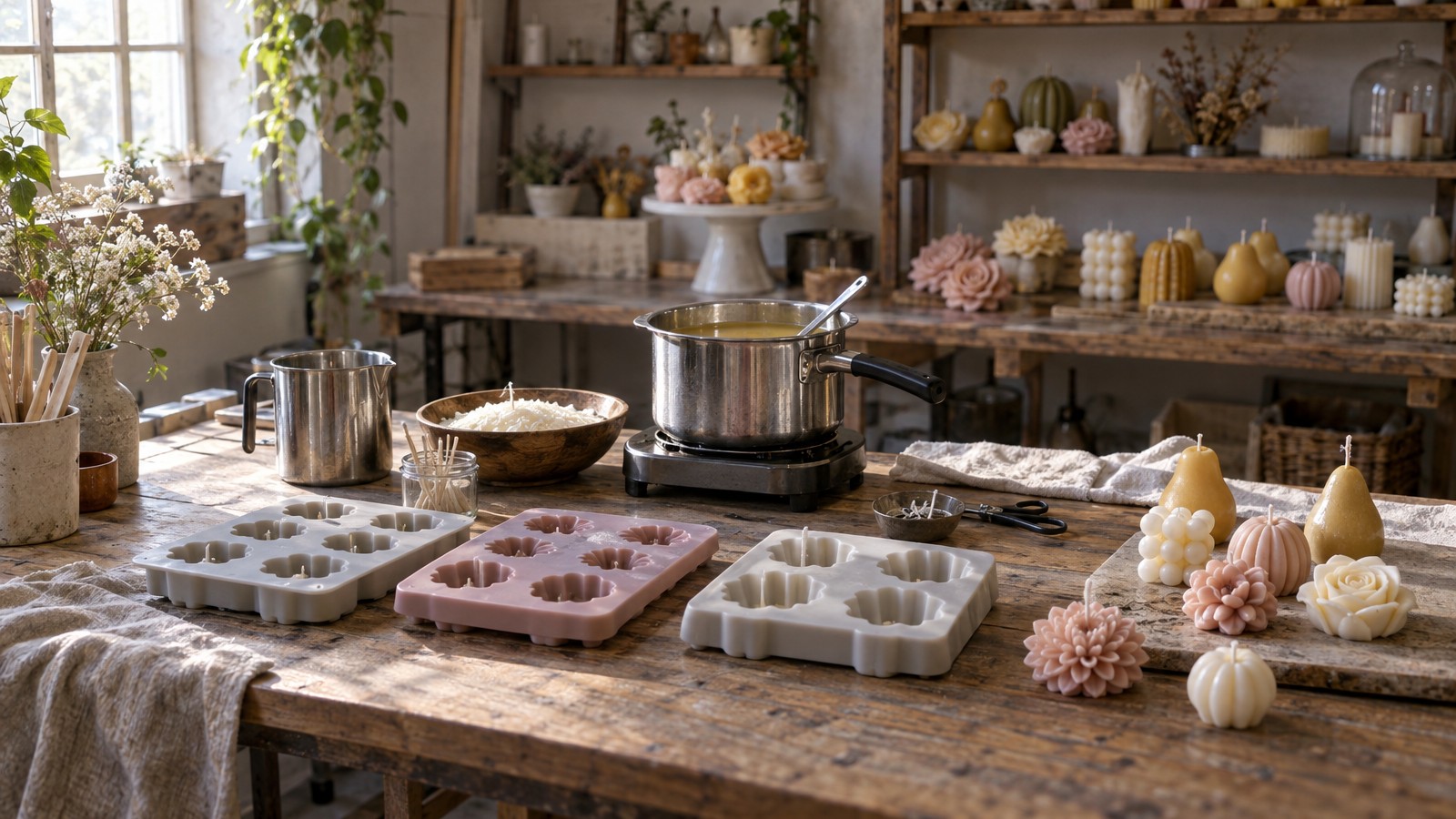
In the workshop, it is quiet and cold before seven in the morning. Silicone molds stand in a row on the workbench — some still damp, some empty — and next to them, a pot where the first batch of wax will heat up in an hour. From the window, you can see a Slovak courtyard, not a production hall. No conveyor belt, no beeping sensors. Just hands, brushes, a thermometer, and patience. A candle that begins to take shape here today will leave the workshop no sooner than two days later. Not because anyone works slowly, but because wax cannot be persuaded to harden faster, and varnish cannot be forced to dry before its time. The term "handmade candle" sounds like one thing. In reality, it conceals two completely different craft processes that only meet in a single phase — during wax pouring. This report will unravel them separately, step by step.
Why it takes days, not minutes
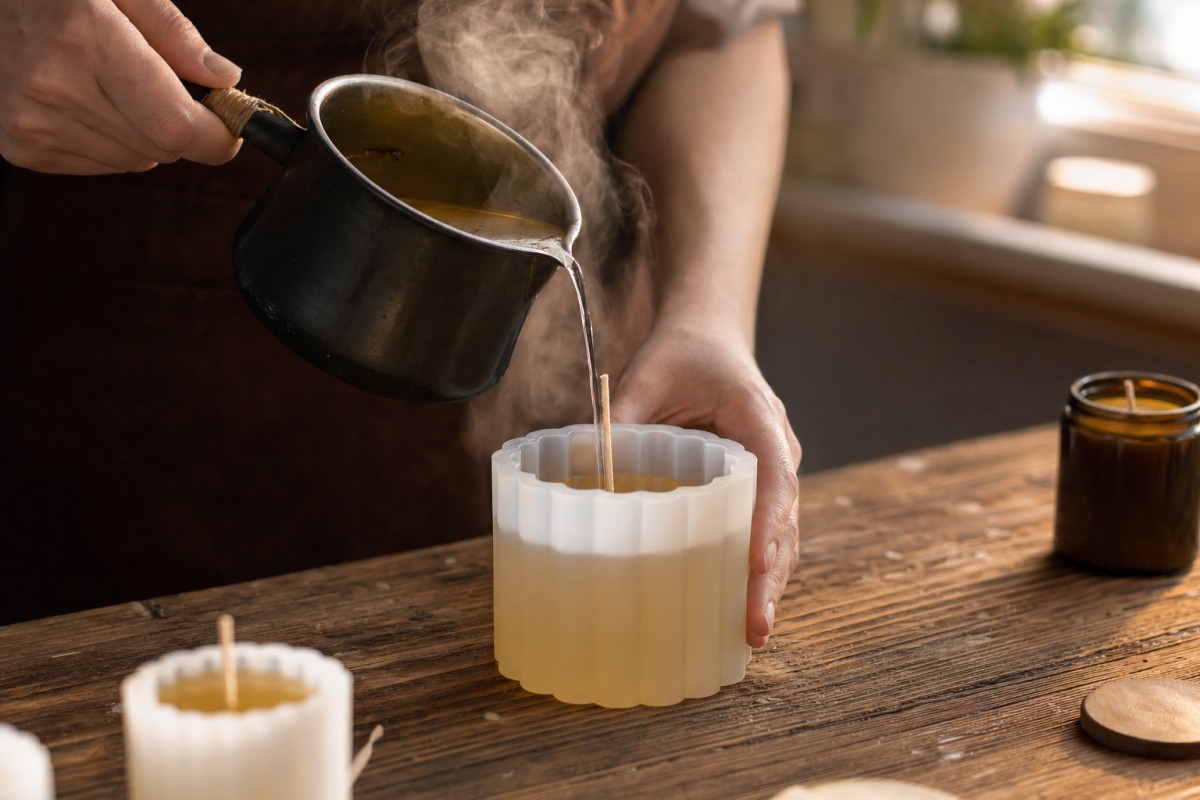
First, something that mass production conceals must be said out loud. An industrial candle is created in minutes. Wax is poured into a plastic container on a belt, cooled by an air stream, wrapped in foil, and sent to a box. Hundreds of pieces per hour. Cheap, predictable, without hands. A handmade candle stands at the opposite end of the same axis. Here, nothing is sped up, because speed means a loss of quality — and that is an unacceptable compromise in this workshop.
Of the total time, only a fraction is purely human labor, somewhere between two to four hours per piece. The rest is waiting. Wax hardens for hours, not minutes, because gradual cooling maintains a stable internal structure without cracks and bubbles. Varnish dries between layers in a dust-free space. The surface is inspected under light, reworked, and finished. All told, one candle passes through the workshop in one to three working days, depending on which of the two paths it takes. A detail that cannot be rushed is not a slogan. It is the physics of the material.
Two paths that only meet at the wax
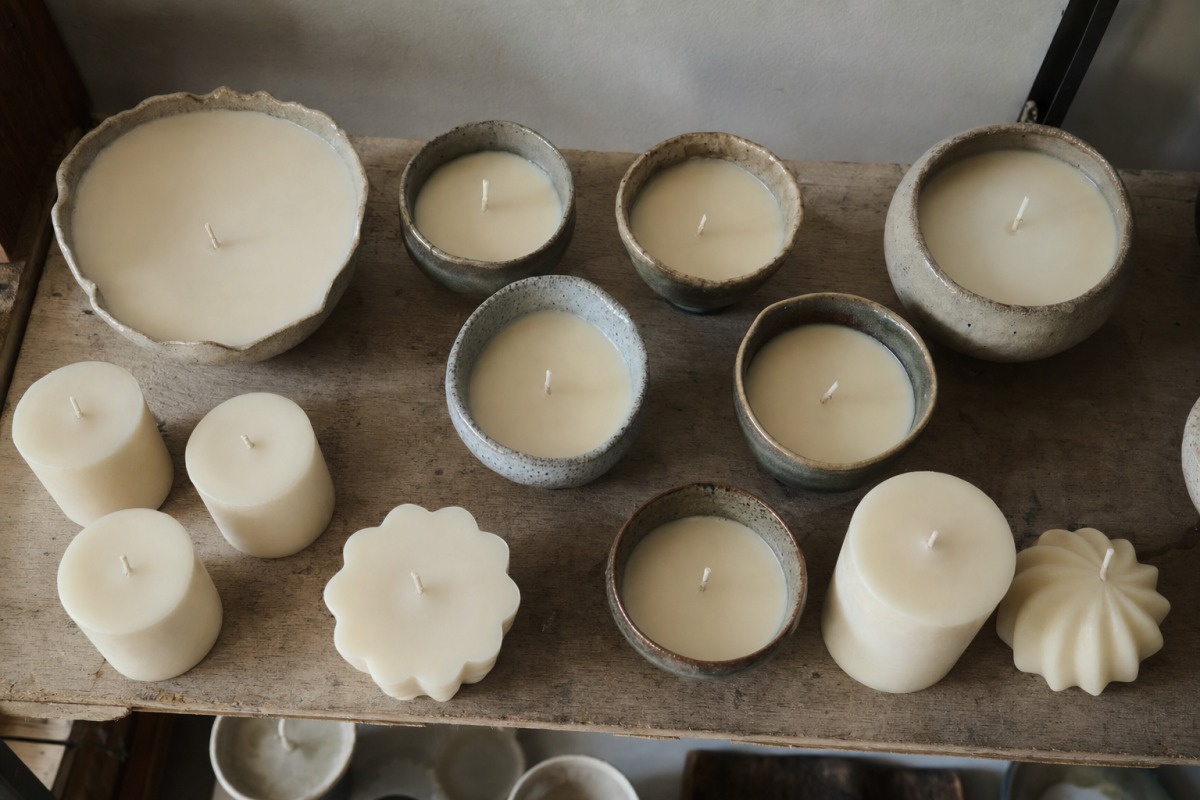
The first thing to understand is the divergence. Under one name, two physically different products exist, sharing almost nothing — until the wax pouring arrives. The first path leads to a free-standing wax candle: a casting in the shape of a raspberry, lotus, flower, or sculpture that stands alone, without a container. The entire piece, every millimeter you see and touch, is wax — both in substance and surface. The second path leads to a candle in a decorative container — a wavy bowl, vase, or sculpturally shaped base. Here, the container is not packaging. It is a separate object with its own life, which persists as an item even after the wax burns out, and the wax is merely its content.
These two paths have a different number of steps, different materials, and different drying times. The free-standing candle passes through the workshop in one to two days and has approximately nine steps. The candle in a container needs two to three days and fourteen steps, because the container must first be made, sanded, and double-coated with varnish, even before the first drop of wax is poured into it. Wax pouring is the only common point of both paths. Everything before it is different — which is why it makes sense to follow each path separately and never mix them into a single list, as most descriptions on the market do. The workshop also physically keeps them separate: a different corner of the table, different varnishes, different rhythm.
First path: a wax casting in nine steps
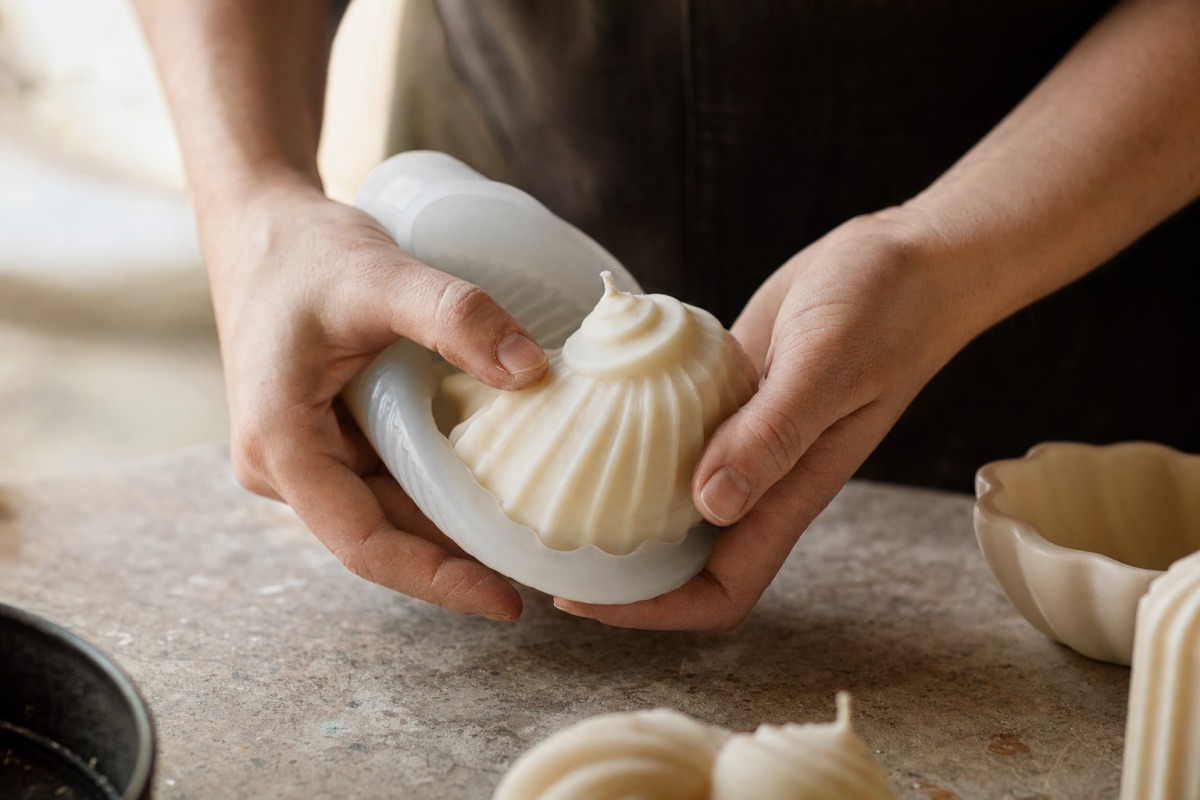
Let's start with the simpler path. A free-standing candle is entirely made of wax, so the process is straightforward — no sanding of containers, no double-layer varnishing of the body. First, a European wick made of pure cotton is threaded into the silicone mold before pouring; its position is decided now, at the beginning, and will determine how the flame burns months later. Then, the wax mixture is prepared — premium vegetable wax from the European Union is heated to the precise pouring temperature and mixed with fragrance and color. Next comes slow pouring into the mold. Fast pouring forces air bubbles into the wax, which later appear as holes on the surface, so it is poured deliberately, drop by drop.
Then comes the quietest step of the entire process — hardening. The wax must not be cooled forcibly, in a refrigerator or by a draft. It hardens on its own, for several hours, and during this time, nothing else can be done in the workshop but wait. When the piece is firm, it is carefully removed from the mold — by hand, without automatic pressures that would deform the delicate shape. The bottom edge is trimmed so the candle stands straight, and for selected models, it is refined with warm air. Here, an optional detail enters, about which there is a separate chapter below — hand painting.
And then comes the step that separates a premium casting from every cheap copy. The raw wax surface is matte, slightly porous, and remembers every fingerprint upon touch. To change this, the piece is sprayed with a special varnish certified directly for candles. This varnish is not random. It is a material from a German manufacturer, developed with the knowledge that the surface being varnished is flammable and heat-sensitive. It contains no solvents that could react during burning, and it is applied in an isolated booth in a thin layer that preserves the details of the casting but seals the surface against fingers and dust. An ordinary workshop either avoids varnishing wax candles altogether or reaches for ordinary wood varnish, which behaves unpredictably upon first ignition. With the right varnish, the surface looks like satin porcelain. Smooth, rich, durable. The last, ninth step is packaging in a protective cover, so the piece arrives without a single fingerprint. Nine steps. One to two days. One material that makes all the difference.
Before and after varnish: a difference you feel immediately
The raw wax candle looks unfinished before varnishing because it is unfinished. Just touch it, and a mark remains on the matte, slightly porous surface. After spraying the varnish, the piece transforms. The surface holds its color for months in the light, does not stick during storage, and withstands daily contact with fingers and dust. The difference between these two states cannot be captured in a photo. You feel it under your fingertips the second you touch the piece. It is precisely this one material — certified candle varnish — that is the main technical dividing line between a premium freestanding candle and its mass-market counterpart.
The second path: a vessel that is created before the candle
The second path is a two-phase process with fourteen steps, because it creates two products in one — first the vessel, then the candle. It begins with a raw casting of material into a silicone mold. The piece solidifies, is removed, and every imperfection is sanded by hand, sometimes edge by edge, sometimes over the entire body. Sanding is slow, laborious work that cannot be skipped — every microscopic unevenness left by haste becomes visible under light after varnishing.
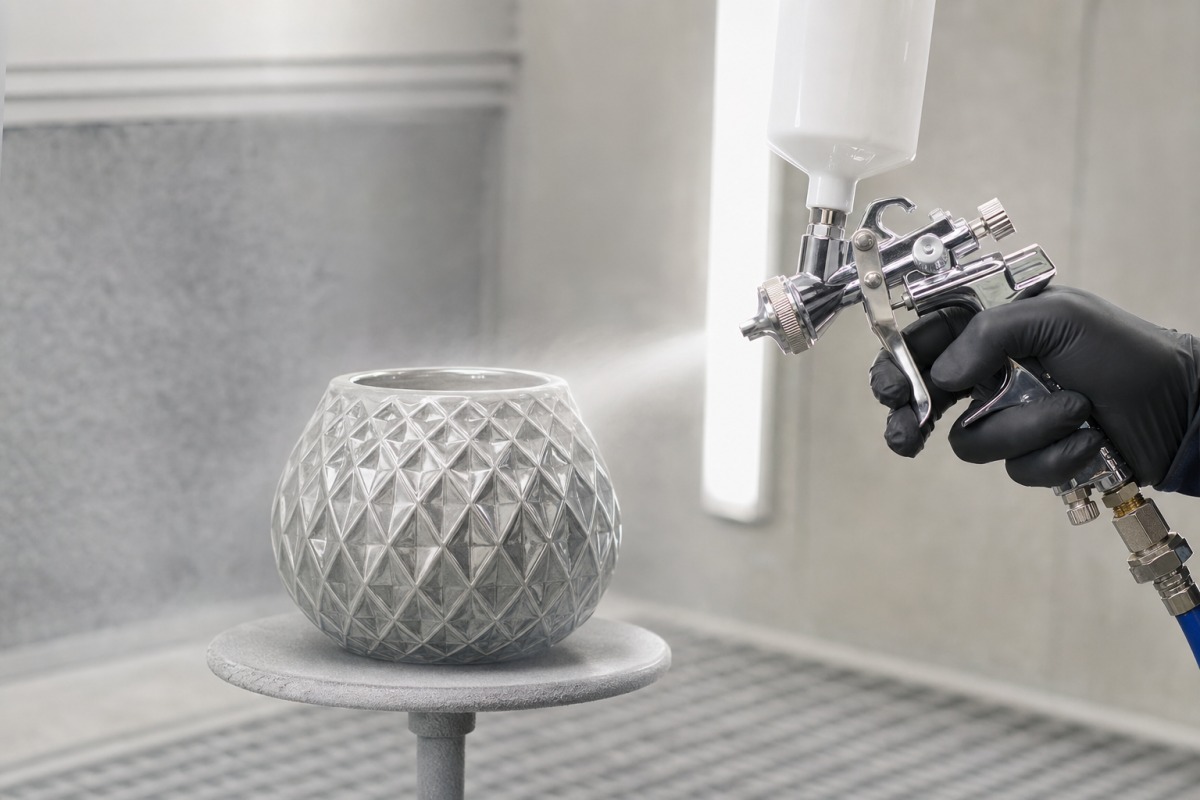
Then comes the two-layer varnishing of the vessel, along with a detail that is invisible but changes everything. The first layer is an acrylic base coat, applied with a professional spray gun in an isolated booth — no brush, no bristle, so that every crevice receives an even film.
After the base layer dries, the second follows: a polyurethane top coat approved for contact with children under European certifications for surfaces in contact with children's toys and furniture — the material has passed toxicology tests, substance migration tests, and saliva resistance tests. In other words, an empty vessel can safely stand on a nightstand in a child's room. Only when the vessel is sanded, double-layer varnished, and inspected under light does the second phase begin — the candle itself. A European cotton wick is glued into the bottom with precise centering. Natural wax is prepared, and fragrance is added. The wax is poured in two phases to keep the wick centered during solidification. After several hours of cooling, the top surface is leveled, the wick is trimmed, the piece undergoes final inspection, and it goes to packaging. Fourteen steps. Two to three days. Two products in one.
Why waiting is not inefficiency
Of the fourteen steps for a candle in a vessel, pure human labor time is two to four hours. The rest is waiting — wax solidification, first varnish layer drying, second layer drying, cooling. The same worker on an industrial line would produce dozens of vessels in the same time. A manual workshop produces one. That waiting is not inefficiency. It is a condition. Wax cooled by force creates internal cracks and an uneven structure that later manifests during burning. Varnish that has not been given time to dry remains soft and attracts dust. Every attempt to shorten these times leaves its mark on the result. The candle does not end up in the box by the second day out of laziness, but because it would not be finished sooner.
Hand painting: a line that a machine cannot replicate
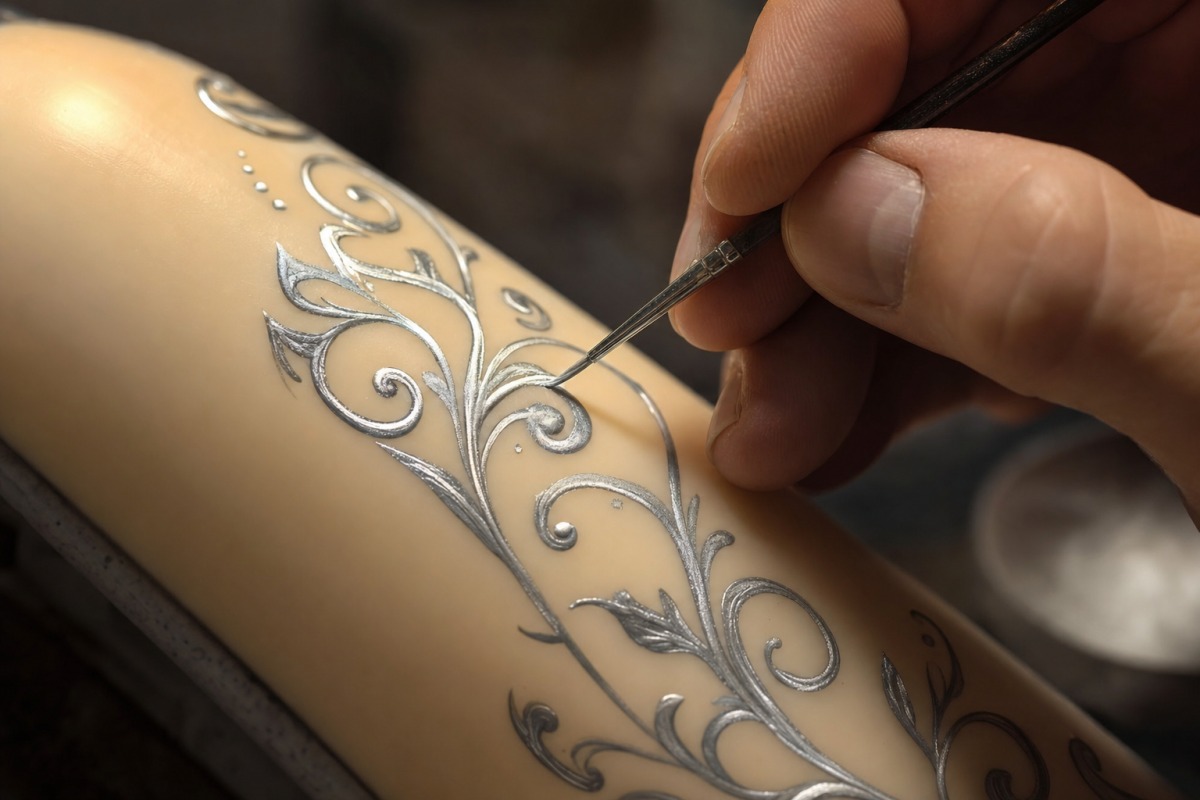
Between sanding and varnishing — on both paths — a phase enters for selected models that turns the piece into an authorial object instead of one among many. Ornaments are painted with a thin brush, freehand, without a stencil: a silver line along the edge, a delicate leaf motif, a geometric pattern. One ornament takes minutes to tens of minutes depending on the complexity of the motif and the size of the piece.
Place three candles from the same series next to each other and you will see differences — somewhere the line is thicker, somewhere thinner, somewhere slightly crooked. That is not a flaw. That is proof that the piece passed through a human hand. Mass production solves such details with decorative foil or digital printing, which sticks to the surface like a sticker and disappears at the first scratch from a fingernail or the first wash. A hand-painted ornament is the opposite. It is layered under the varnish, becomes part of the surface, and lasts for the entire life of the candle, even after the wax has burned down. When purchasing, you are not choosing a type. You are choosing a specific piece with its own microscopic deviation.
Materials that carry the entire structure
None of these processes would make sense on a poor foundation. That is why paraffin — a petroleum derivative that costs a few euros but releases traces of unburned soot that settles on ceilings and curtains when burned — is not the base. Natural vegetable wax from the European Union is poured. It burns slowly and evenly. The fragrances are premium compositions made according to the IFRA standard, at a concentration that rarely appears on the packaging but determines whether the candle truly smells or just pretends to. That difference is not visible through glass. When lit, you feel it immediately — the fragrance fills an average living room within ten to fifteen minutes and lingers in fabrics until the next day.
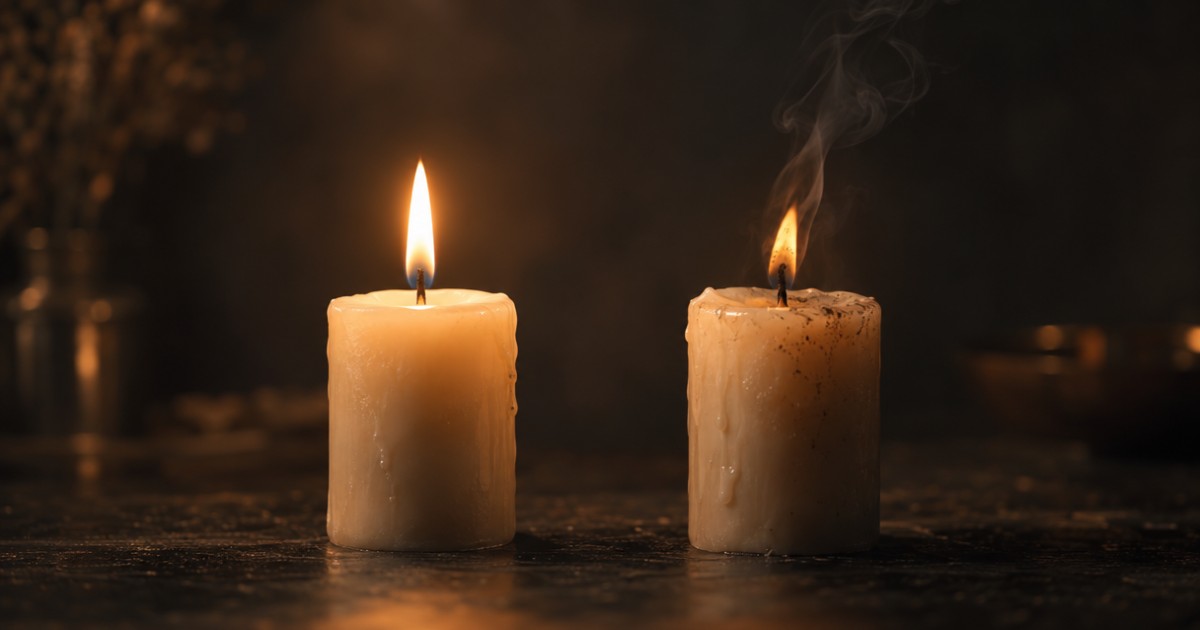
The last article is the wick. A cheap wick is usually soaked in an unidentified paraffin mixture and, when burning, releases a thin stream of black smoke visible at the opening. Here, European wicks made of pure cotton are used, without paraffin impregnation, with a narrow metal base that keeps the flame stable even at the last centimeter of wax. The flame is even, yellow with a golden edge, without a smoke trail. Three raw materials — wax, fragrance, wick. Each from the European Union, each with a declared origin. A cheaper variant works differently too. Just not as cleanly.
What the person who lights the candle gets out of it
A report from the workshop would be just a curiosity if all that time didn't manifest in the finished piece. It does manifest, and measurably. When the last piece disappears into its protective packaging, the sum of everything that came before remains visible: a surface that withstands daily touch and still shines after a year on the shelf. A fragrance that fills the room in minutes and lingers in fabrics until the next day, not just while the flame burns. A flame without soot. And with a candle in a container, something extra — a container that remains after burning out as a jewelry dish, a dried flower vase, or an object on the dresser. The difference between a candle from a production line and a candle from a workshop cannot be captured in a photo. You feel it — in how long it smells, and how it looks a year later.
Two days of work, nine or fourteen steps, two distinct craft paths, and dozens of human touches — all of this lies behind a single handmade candle from a Slovak workshop. It is not an object made for a quick effect. It is an object built on a different logic, one that lives in your home for years even after the wax has burned out. Anyone who wants to see what this process looks like in a finished piece should check out the collection of candles from NOBAMO and choose a shape, a fragrance, and a piece that bears its own, unique hand.

Founder and owner of e-shops, father of two daughters and husband of Majka. Enthusiast for quality items with a well-thought-out story — from jewelry and watches to fashion accessories. He runs his stores with the same care he devotes to his family: he selects brands and products that he would buy for his loved ones. He regularly writes about how to choose a piece that will last for years.
All articles by author
 Container Candles
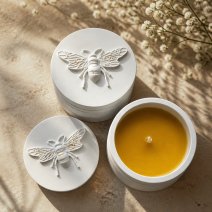
Bee Candle - White
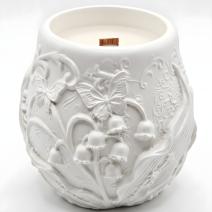
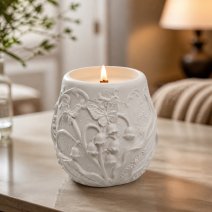
Convallaria Candle - White / Milk, Honey
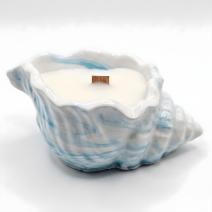
Candle Wave - Blue / Vanilla
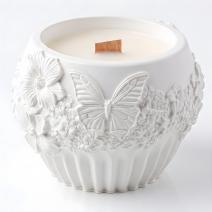

Candle Meadow - White / Cherry, Almond
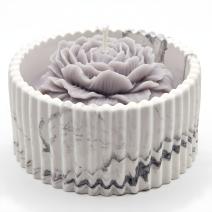
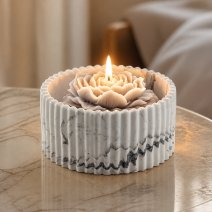
Carrara Candle - Peony / White / Silver / Lime, Mango
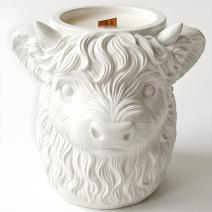

Highland Cow Candle - White / Vanilla
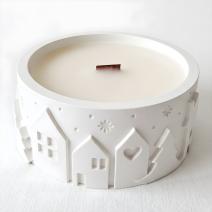

Winter Landscape Candle - White / Milk, Honey
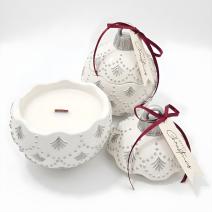
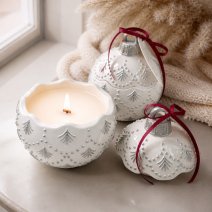
Christmas Bauble Enchanted Candle - White / Silver / Winter Magic
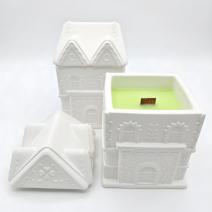
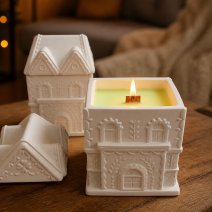
Medium House Candle - White / Apple, Cinnamon



Comments
Add comment
Login required
To add a comment, you must log in to your account.
Don't have an account? Register